


I recently spoke with two construction business owners. The call started like most discovery calls do.
Two directors. A solid construction and utilities business turning over about £2 million. Busy, growing, and on the surface, doing well.
They weren’t stressed. They weren’t firefighting. If anything, they sounded fairly positive about how things were going.
“We’re busy,” one of them said. “Turnover’s grown nicely over the last couple of years. Profit’s up as well.”
That’s usually the point where I ask why they’ve booked the call.
There was a brief pause.
Then, almost in passing, one of them added, “We did lose a chunk of work with Balfour Beatty earlier this year. Nothing dramatic. They just pulled back a bit.”
I asked what he meant.
“We’d been doing regular work for them. Roughly half a million a year. They reviewed our accounts and said they couldn’t give us more work for now. Didn’t go into much detail. Just said the numbers didn’t quite stack up.”
They weren’t angry about it. More confused than anything else.
“Our accountant says we’re doing well,” the other director said. “Revenue’s up. Profit’s up. So we couldn’t really see the issue.”
I asked them to send over their most recent accounts.
When I opened the balance sheet, the problem was immediately obvious.
It wasn’t hidden in the detail. It wasn’t a complex technical adjustment.
It was one number.
Current ratio: 0.99.
What I Saw (And What They Didn’t)
Here’s what their balance sheet showed.
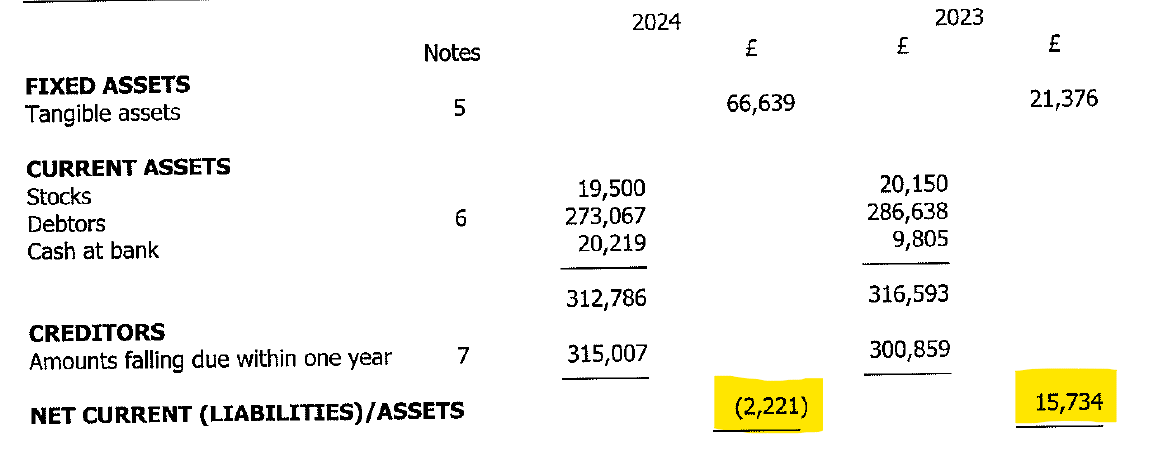
Net current liabilities of £2,221.
In simple terms, for every £1 they owed in the next 12 months, they only had 99p coming in.
That doesn’t mean the business was about to collapse tomorrow. But it does mean there was no buffer. No resilience. No capacity to absorb the things that regularly go wrong in construction.
What made it more concerning was the direction of travel.
The previous year, their working capital had been positive £15,734. Not a huge amount, but at least on the right side of the line.
Twelve months later, despite higher revenue and higher profit, that position had reversed.
Revenue was growing. Profit was improving. But the financial foundation underneath the business was thinning out.
I explained it to them like this: “If everything goes to plan, you get by. If one thing goes wrong – a late payment, a job that overruns, retention taking longer to release – you’re immediately under pressure.”
One of them nodded slowly. “Our accountant never mentioned that.”
The other asked, “What exactly is that number? And why does it matter so much?”
This is over-trading.
And it explains why Balfour Beatty quietly pulled back.
Why “Doing Well” Wasn’t Good Enough
To be clear, their accountant hadn’t lied to them.
Profit had increased from £19,000 to £47,000. Revenue was up. Tax was dealt with properly. From an HMRC perspective, the year probably looked fine.
The issue wasn’t accuracy. It was focus.
Their accountant was optimising for HMRC.
Balfour Beatty was assessing risk.
Those are two very different audiences, and they care about very different things.
Most construction business owners naturally focus on:
But when banks, funders, and procurement teams assess your business, they don’t start with the profit and loss account.
They start with the balance sheet.
Specifically, they want to know whether your business has enough working capital to survive their payment terms without relying on luck.
If the honest answer is “only just”, that’s a risk. Even if the business is profitable.
What Over-Trading Actually Means
Over-trading isn’t about being reckless or badly run.
It simply means you’re growing revenue faster than you’re growing working capital.
In practical terms, you’re spending money to deliver projects quicker than you’re collecting it back.
Every job requires cash going out before cash comes in:
Meanwhile, the client pays you 60 to 90 days later.
That timing gap has to be funded somehow. That’s what working capital does.
As businesses grow, that gap usually gets wider, not smaller.
At around £500,000 of revenue, you might operate comfortably with £40,000 to £60,000 of working capital.
At £2 million, you might need £200,000 or more.
But many businesses hit £2 million still operating on a cash base designed for a much smaller operation. They’re effectively trying to run a £2 million business with the financial resilience of a £500,000 one.
That’s over-trading.
What the Procurement Team Would Have Seen
I asked the directors to look at their figures from the other side of the table.
Assets of £312,500. Liabilities of £315,000. A current ratio just under 1.
I explained it this way: “There’s no shock absorber here.”
If a client pays late, there’s nowhere to hide.
If a project overruns, it immediately creates pressure elsewhere.
If retention sits longer than expected, the strain shows up straight away.
So when a main contractor is deciding whether to allocate another £500,000 of work on 60-day terms, they’re not asking whether you made a profit last year.
They’re asking whether your balance sheet can carry the cash strain of their payment cycle.
With a current ratio below 1, the answer is usually no.
Not because the business is bad. Because it’s fragile.
Why Profitable Companies Still Go Bust
This is the pattern I see repeatedly.
Revenue grows. Profit grows. Confidence grows.
But working capital doesn’t keep pace.
On the profit and loss account, everything looks like success.
On the balance sheet, the margin for error is shrinking.
Banks see it. Procurement teams see it. Suppliers often see it before anyone else.
The business looks fine right up until the point it isn’t.
The Early Warning Signs
Most owners feel over-trading before they can explain it.
Cash always feels tight despite growth.
You’re doing mental arithmetic on Sunday nights.
You turn down work not because of capacity, but because you can’t afford to fund another job.
Suppliers start nudging payment terms.
Clients hesitate, even though your accountant says you’ve had a “good year”.
One of the directors said to me later, “We thought the stress was just part of growing. Everyone we knew felt the same.”
It isn’t part of growing.
It’s a warning sign.
How Businesses Drift Into Over-Trading
It rarely comes from one decision.
More often it’s a combination of:
Each issue on its own feels manageable. Together, they create a business that looks successful but is financially stretched.
The Way Out
The solution isn’t clever. It’s disciplined.
Growth sometimes needs to pause so cash can catch up.
Working capital buffers need to be built deliberately, not accidentally.
Payment structures matter more than headline contract values.
WIP needs to be tracked properly so you know where cash is tied up.
Most importantly, someone needs to be watching the balance sheet regularly, not just the profit figure at year end.
A Simple Self-Check
Pull your latest accounts and ask yourself three questions:
If you can’t, you don’t have visibility. And without visibility, you’re relying on luck.
The Bottom Line
Over-trading kills construction businesses.
Not because they’re unprofitable, but because they’re under-capitalised.
Revenue grows. Profit grows. But working capital quietly erodes.
Eventually, something small tips it over.
Profit looks good on paper.
Working capital keeps you alive.
Know it. Track it. Build it.
Before someone else reads your accounts and decides you’re too risky to trust.

We will never spam or sell your info. Ever.